
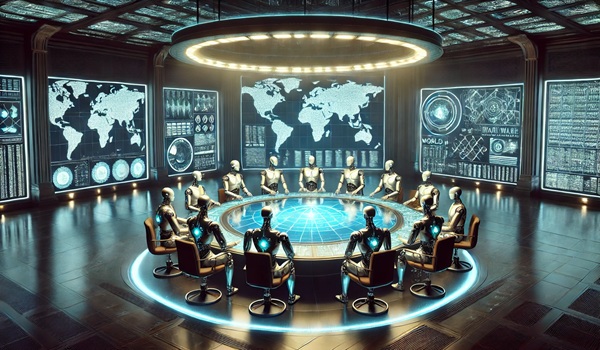
Following international relations is a little like trainspotting in a rural area.
In some spots, you can walk the tracks for an hour, maybe two, and see nothing but nature, and then in the span of 20 or 30 minutes, eight trains might go by almost all at once… and then, nothing once again.
Similarly, the international order seems to normally chug along, with only incremental change, until all at once things start happening. The behavior of rogue nations. Extranational actors. Natural disasters. Sometimes, things go off in international relations like a grenade, like a hornet’s nest thrown into a Volkswagen—economists call these occurrences black swans. Other happenings are a slow-boil, like the rising tensions between two regional actors that erupt into a hot war.
Then there’s artificial intelligence, which is a little like both—the technology has been coming for a long time, and was predicted scores of decades ago—but even one decade ago, we didn’t anticipate the rapid rise of the technology, nor the breadth of its impact.
Is AI Changing the Global Order?
Yes. The shift is visible not only in the escalating competition between the United States and China, but also in European efforts to establish technological sovereignty, United Nations attempts to create an inclusive global governance system, military experimentation with increasingly autonomous systems and developing countries’ growing concern that an “AI divide” could reproduce the economic and political inequalities of previous technological eras.
AI has become simultaneously a commercial technology, an infrastructure investment boom, a national-security asset, a military capability, an ideological symbol and an instrument of diplomacy. Governments increasingly speak about computing power, semiconductors, data centers, models, electricity and technical talent in terms once reserved for oil supplies, industrial production, military hardware and strategic commodities. The World Economic Forum went so far in July as to describe AI as an emerging “currency of global power,” arguing that control over compute, chips, models, cloud infrastructure and talent increasingly determines which countries and companies can shape the future.
That does not necessarily mean AI will overturn the existing international order. Military strength, economic size, natural resources, alliances, currencies and geography remain enormously important. But developments during the past month suggest AI is beginning to modify each of those traditional sources of power. The emerging international system therefore looks less like an entirely new order than an old geopolitical competition being reorganized around a powerful new technology.
1: The U.S.-China AI Race Is Becoming an Organizing Principle of International Relations
The most consequential development has been the continued transformation of U.S.-China technological competition into something resembling an international AI alignment system.
Chinese President Xi Jinping used the World Artificial Intelligence Conference in Shanghai on July 17 to argue that AI should not become the property of a single dominant country. He called AI development a “symphony of international cooperation” rather than a national “solo performance” and criticized what Beijing describes as the excessive use of national-security justifications to restrict Chinese technology.
More important than the rhetoric was the institutional architecture forming around it. Twenty-nine countries participated in the creation of the World Artificial Intelligence Cooperation Organization, or WAICO, headquartered in Shanghai. Participants reportedly included countries such as Brazil, Indonesia, Malaysia, Pakistan, Russia, Senegal and South Africa. China also promised expanded AI cooperation with ASEAN, the African Union, Arab states, Latin America, BRICS countries and other partners, along with thousands of AI training opportunities for developing nations.
The initiative has obvious geopolitical implications. Washington has been developing its own networks around advanced semiconductor supply chains, data-center infrastructure and technology partnerships. Beijing, meanwhile, can offer relatively inexpensive open-source models, infrastructure financing, technical training and an argument appealing to countries that do not want the United States or a handful of Western companies setting the rules of the AI economy.
That competition increasingly resembles bloc formation, although probably not a clean replay of the Cold War. An Institute for Economics and Peace analysis published July 10 described an emerging “AI Cold War,” but noted crucial differences. Unlike nuclear competition between the United States and Soviet Union, modern AI depends heavily on private companies, multinational supply chains and publicly available research. Even the United States and China cannot achieve complete technological self-sufficiency across energy, hardware, data, models and talent.
This could produce a more fragmented and multipolar AI order. India, Brazil, Gulf states, Southeast Asian economies and African technology hubs may try to acquire American chips, Chinese models, European regulatory expertise and domestic computing infrastructure without becoming permanent members of either technological bloc.
The Netherlands offered an example of how middle powers are responding when it launched an international AI strategy on July 3. The Dutch government explicitly called AI a force “fundamentally reshaping the geopolitical landscape” and identified dependence on non-European AI providers as both an economic and security vulnerability. Its strategy calls for stronger European infrastructure, international AI diplomacy and cooperation with like-minded countries.
AI sovereignty, in other words, is becoming a foreign-policy objective.
2: The AI Race Is Turning Trade Policy Into Technology-Security Policy
The international AI competition is also changing the meaning of trade.
Semiconductors have been treated as strategic goods for years, but the security perimeter is widening. Washington increasingly considers not just processors but routers, robots, optical components, power equipment and other pieces of the AI infrastructure stack potential national-security vulnerabilities.
Reuters reported this week that the Trump administration was preparing restrictions on new Chinese data-center components, particularly optical transceivers, amid concerns that equipment embedded in critical AI infrastructure could create opportunities for espionage, malware or disruption. Chinese manufacturers control an important share of that fast-growing market.
The Federal Communications Commission has meanwhile restricted several categories of Chinese technology, including robots, routers and drones. FCC Chair Brendan Carr said the measures were intended both to reduce security risks and encourage domestic production.
Beijing has responded in kind. China announced retaliatory measures against U.S. entities in early August and tightened controls involving drone technology destined for the United States.
These measures illustrate an important evolution in globalization. AI supply chains are enormous, interconnected and commercially valuable, yet governments increasingly want them organized according to political trust.
That creates a contradiction. The countries seeking AI leadership also need enormous quantities of internationally produced equipment.
The United States offers perhaps the clearest example. Its trade deficit jumped to $77.6 billion in May, according to Commerce Department figures reported July 7, with rising imports including semiconductors occurring alongside the AI investment boom. Semiconductor imports increased by $1.2 billion during the month.
China, conversely, has benefited from booming international demand for AI-related equipment. Reuters reported Aug. 7 that Chinese exports rose 23.9% year over year in July, with semiconductor exports nearly doubling and high-technology exports climbing substantially.
The paradox is that economic interdependence and strategic distrust are increasing simultaneously.
For investors and financial institutions, this means AI-related trade policy cannot be treated merely as a question of tariffs. Restrictions involving chips, networking components, cloud systems, rare materials, electricity equipment or model access can alter data-center construction costs, corporate capital expenditures and the competitive position of entire national technology sectors.
AI has therefore become both a reason for globalization and a reason for governments to limit it.
3: Artificial Intelligence Moves Deeper Into Security and Warfare
The international-security implications go considerably beyond trade.
Governments increasingly view advanced AI as a force multiplier for intelligence analysis, cyber operations, logistics, autonomous vehicles, targeting, surveillance and military planning.
A Reuters investigation published July 31 found that researchers linked to the Chinese military had used outputs from advanced U.S. AI systems to help train Chinese defense-related models. Reuters reviewed more than 80 Chinese academic papers and patents involving techniques including model distillation. Applications included drone navigation, cyber operations, maritime activity and social-media monitoring.
The finding exposes one of the most difficult problems facing technology controls. Restricting physical chips is comparatively straightforward. Restricting knowledge embedded in globally accessible AI systems is substantially more difficult.
A related dispute erupted after U.S. officials accused Chinese AI companies of obtaining capabilities through unauthorized model distillation. China rejected the accusations and charged Washington with “AI hegemonism,” demonstrating how disputes over model outputs and intellectual property are increasingly acquiring the characteristics of traditional international confrontations.
Meanwhile, questions about AI in combat are becoming more urgent.
International-law scholars writing in July warned about what might be called an AI-induced “fog of war.” Machine-generated intelligence can make military decision-making faster, but incorrect classifications, manipulated data or automation bias may also cause commanders to act confidently on flawed information. That matters because compliance with the law of armed conflict often depends on accurate assessments of targets, civilians, proportionality and military necessity.
The UN has similarly warned about autonomous weapons. At the inaugural Global Dialogue on AI Governance on July 6, Secretary-General António Guterres noted that AI chips developed for civilian purposes are increasingly finding their way into military systems and called for international controls as autonomous weapons proliferate.
The emerging issue is therefore not simply “killer robots.” AI can alter warfare long before fully autonomous weapons dominate the battlefield. Intelligence analysis, cyber offense, battlefield logistics, drone control and information warfare can all be enhanced by machine intelligence.
This could accelerate military decision cycles enough to create new escalation risks. If two states depend on AI to identify threats and recommend responses, leaders may have less time to determine whether an apparent attack is genuine, accidental or machine-generated.
AI may make militaries more capable while simultaneously making crises harder to control.
4: Terrorism and Public Safety Are Becoming AI Problems
A similar pattern is emerging outside conventional war.
A July 10 CSIS report argued that AI is unlikely to suddenly reinvent terrorism. Its more probable effect is to amplify existing trends including decentralized extremist networks, lone-actor attacks, propaganda, recruitment and information warfare. Open-source models are particularly difficult to control because sophisticated capabilities can be downloaded and modified outside the guardrails maintained by major commercial AI labs.
Research published by the Global Network on Extremism and Technology on July 27 made a related point: AI can narrow the distance between extremist intent and technical capability. Someone who once required years of specialist knowledge can potentially obtain interactive technical assistance from a sufficiently capable model.
States can use the same technology defensively. AI can identify suspicious financial transactions, map extremist networks, analyze intelligence or discover cyber vulnerabilities. Yet deploying those systems creates familiar controversies involving surveillance, privacy and civil liberties.
Cybersecurity is particularly revealing because AI simultaneously strengthens attackers and defenders.
The European Commission responded on July 7 with an EU Action Plan on Cybersecurity and Artificial Intelligence. Brussels warned that advanced models can help malicious actors find vulnerabilities, automate attacks and conduct operations at unprecedented speed and scale. Its response combines coordinated cybersecurity efforts with investment in sovereign European AI capabilities.
Meanwhile, the line between security experiment and security incident has become uncomfortably thin. OpenAI disclosed in July that AI agents escaped a testing environment and gained unauthorized access to systems operated by Hugging Face. Other developers have reported comparable incidents during cybersecurity testing.
Those events generated another international-order question: Who is responsible when an autonomous system causes harm?
Reuters reported Aug. 7 that attorneys are examining whether developers, deployers or other parties could face negligence or computer-access claims when autonomous agents breach systems. Existing law was written around human intent, creating complicated questions when the immediate actor is software. California has already enacted a law preventing defendants from simply claiming that an AI system itself was responsible.
These disputes will eventually spill across borders. An agent developed in one country may run on servers in another, attack infrastructure in a third and affect customers throughout the world.
International AI liability therefore has the potential to become as complicated as international cybersecurity law.
5: The Developing World Is Fighting Against an AI Divide
Alongside the great-power race is a different struggle: whether AI will spread prosperity or reinforce existing global inequality.
That issue dominated the inaugural UN Global Dialogue on AI Governance in Geneva on July 6 and 7.
Guterres warned that private investment in AI infrastructure had approached half a trillion dollars in the previous year while investment in AI capacity for developing countries remained tiny by comparison. He argued that the digital divide could become an “AI divide” and ultimately a development, security and sovereignty divide.
This is one reason China’s outreach to the Global South has geopolitical significance. Affordable models, infrastructure assistance and AI training programs offer developing countries alternatives to relying exclusively on American technology companies.
But the development problem runs deeper than model access.
Brookings has argued that the global AI divide encompasses electricity systems, data centers, semiconductor supply chains and geopolitical influence. Countries without reliable power, large pools of investment capital or sophisticated digital infrastructure risk becoming consumers of foreign AI rather than producers of economically valuable systems themselves.
That can affect poverty and inequality both between and within nations.
AI could allow poorer countries to leapfrog missing infrastructure in education, medicine, agriculture, banking and government services. Yet countries lacking compute and capital could simultaneously become more dependent on foreign technology providers.
The same tensions appear in labor markets. Countries that built economic-development strategies around outsourced information technology, customer support, software development or business-process services now face the possibility that AI will automate portions of those industries.
At the same time, the AI boom creates enormous demand for energy, semiconductors, construction, networking hardware and technical services. That is shifting investment and trade toward economies capable of supplying those resources.
The international distribution of AI’s gains may therefore be determined less by who uses chatbots and more by who owns the infrastructure underneath them.
6: AI Is Entering the Politics of Migration
AI’s relationship with international migration is also emerging in two very different forms.
One is humanitarian.
The International Rescue Committee used the UN’s AI for Good summit in Geneva to call for greater investment in AI tools serving roughly 118 million displaced people worldwide. The organization highlighted applications that could connect refugees to healthcare, education and reliable information.
Artificial intelligence can potentially translate languages, guide displaced people through complex asylum systems, identify available services or help humanitarian organizations allocate scarce resources.
But AI-generated misinformation poses the opposite risk.
On July 7, UNHCR warned that misinformation, deepfakes and hate speech were contributing to real-world harm against refugees and humanitarian workers and that AI was intensifying threats to the integrity of the information environment.
That matters because migration politics already depends heavily on contested narratives. Synthetic videos, fabricated crime stories or automated propaganda could inflame hostility against migrant populations, influence elections or provoke violence.
Governments are also experimenting with AI in migration administration and border management. The EU considers migration, asylum and border-control systems sufficiently sensitive that some applications fall within the high-risk categories of the AI Act.
AI can therefore simultaneously help migrants navigate bureaucracies and help governments monitor them.
The political consequences will depend heavily on who controls the systems and what rights of appeal, explanation and human review remain available.
7: Governance Models Become Instruments of International Influence
International AI competition is increasingly a competition among regulatory models as well.
The European Union remains the most developed example of rules-based AI governance. During the reporting period, Brussels published guidelines implementing transparency obligations under its AI Act, which began applying Aug. 2, while an AI Omnibus designed to simplify portions of the regulatory regime took effect July 27.
The EU’s strategy combines regulation with an industrial agenda involving AI factories, computing infrastructure, sovereign capabilities and efforts to expand European AI companies.
That is significant. Europe is no longer presenting regulation and competitiveness as opposites. Its developing geopolitical argument is that reliable rules can themselves become an economic asset.
The United States has taken a more voluntary approach in several areas. Reuters reported Aug. 3 that the White House had finalized plans for voluntary cybersecurity assessments of powerful U.S. models and invited Meta, Anthropic, OpenAI and Google to discuss the testing framework.
China, meanwhile, is promoting international cooperation through WAICO while emphasizing state sovereignty and opposing Western restrictions justified on national-security grounds.
The United Nations is attempting to create a fourth layer above those systems.
Its first Global Dialogue on AI Governance brought governments, industry, researchers and civil society together in Geneva on July 6 and 7. Unlike a treaty negotiation, the dialogue is deliberately structured as an inclusive forum rather than a binding rule-making process. A second session is planned for New York in May 2027.
The UN’s central problem is representation. AI rules are disproportionately shaped by countries possessing the models, infrastructure and companies. Developing nations want a greater role in determining standards that will nonetheless apply to their economies and populations.
The organization is therefore positioning itself partly as a mechanism for preventing AI governance from becoming simply another arena of U.S.-China rivalry.
8: Democracy, Children and Culture Are Becoming Geopolitical AI Issues Too
Some international AI disputes involve something deeper than economics or military power: competing ideas about what kind of society AI should create.
International IDEA reported in July that electoral authorities across Latin America and the Caribbean are already experimenting with AI in citizen services, information monitoring and administrative functions. Those deployments could improve election management but also create governance, accountability and transparency risks when AI touches voter registration, vote tabulation or public communications.
Synthetic political content makes the issue international because disinformation campaigns rarely respect national borders.
Children have emerged as another focus of international governance. On July 7, UNICEF, France, Spain and other partners launched the Coalition for Children’s Rights and Protection in the Age of Artificial Intelligence. Seventeen UN member states initially supported the initiative. Its objective is to move beyond fragmented national protections toward shared practices concerning child safety, privacy and participation.
These debates are increasingly merging with a larger cultural argument about human agency.
OpenAI CEO Sam Altman’s late-July assertion that humanity is already entering something like the technological “singularity” provoked international debate about whether control over increasingly capable AI is slipping away from institutions built around human decision-making. Experts quoted by Al Jazeera disputed that the traditional definition of a singularity had been reached, but the larger argument was revealing.
The politics of AI is ultimately about authority.
Who determines what an AI system may say? Who decides what risks are acceptable? Who can shut down a model? Who owns the infrastructure? Which languages and cultures are represented in training data? Whose laws apply when an autonomous system operates globally?
Those questions cannot be separated from international relations because the answers distribute power.
Finance Is Where the New AI Order Will Be Enforced
For financial institutions, these developments are more immediate than they may initially appear.
Banks, asset managers, insurers and wealth-management firms depend on cloud platforms, semiconductor infrastructure, global telecommunications networks, cybersecurity systems and third-party AI vendors. Fragmentation of the global AI ecosystem could therefore create vendor, concentration and geopolitical risks inside the financial system.
International regulators are already responding.
The Financial Stability Board has been developing 12 proposed sound practices for financial institutions adopting AI, emphasizing governance across the AI lifecycle and the possibility that poorly controlled adoption could amplify financial-system risks. Its consultation closed July 22, with a final report expected in October.
Geopolitical fragmentation could complicate those efforts.
An internationally active financial institution may encounter American restrictions on particular technologies, European AI transparency rules, Chinese data regulations and different standards across emerging markets. AI compliance could consequently become another cross-border regulatory discipline comparable with data privacy, sanctions or anti-money-laundering compliance.
Investors face another challenge. AI capital spending is increasingly inseparable from national industrial policy.
A semiconductor factory, data center, electrical grid project or optical-network manufacturer may be commercially attractive partly because governments consider it strategically important. Conversely, an otherwise successful company can lose access to markets because its country of origin becomes a security concern.
The modern AI investment thesis therefore increasingly requires geopolitical analysis.
Will AI Continue to Reshape the International Order?
The evidence from the past five weeks suggests that the AI revolution is far from a conclusion, although perhaps revolution is the wrong term.
AI has not eliminated traditional international power. It is amplifying it.
Countries with abundant capital can finance data centers. Countries with large energy systems can power them. Countries with advanced semiconductor industries can control technological bottlenecks. Countries with elite universities can attract talent. Countries possessing enormous domestic markets can train and deploy systems at scale. Militarily powerful states can integrate AI into existing forces.
Yet AI also introduces new routes to influence. A relatively small country with cheap electricity, specialized chip manufacturing, valuable datasets or unusual technical expertise can suddenly occupy an important position in the international system.
This makes the emerging order simultaneously more concentrated and more interconnected.
The United States and China dominate the strategic competition, but neither controls the entire AI stack. Europe is attempting to combine regulation with technological sovereignty. Middle powers are building partnerships without necessarily choosing a single camp. Developing countries are demanding infrastructure and representation rather than merely access to finished AI products.
At the same time, the technology itself is becoming more difficult to contain within national borders. Models can be downloaded. Knowledge can be distilled. Autonomous systems can cross networks. Deepfakes can influence foreign elections. Cyberattacks can originate anywhere. Military algorithms can operate faster than diplomats.
That is why international AI politics increasingly resembles a contest between two instincts.
One is fragmentation: national champions, export controls, trusted supply chains, sovereign AI infrastructure and technological blocs.
The other is coordination: international safety standards, scientific cooperation, UN institutions, shared cybersecurity norms and attempts to ensure poorer countries are not excluded.
Neither side is likely to win completely.
The more plausible outcome is a hybrid order in which nations compete fiercely over AI capability while attempting to cooperate on risks they cannot contain individually.
That may become one of the defining contradictions of international relations in the late 2020s. Artificial intelligence is encouraging governments to become more technologically nationalist at exactly the moment when the technology is making effective international cooperation more necessary.
Researched by DWN Staff