
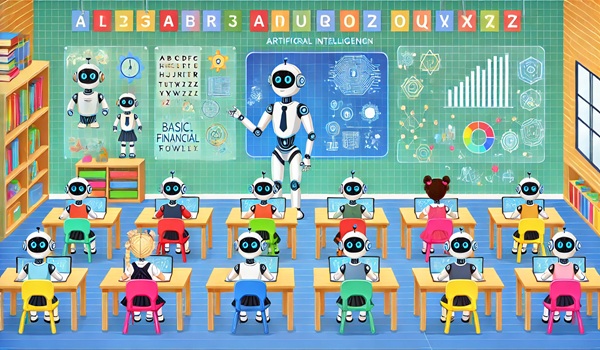
Each week we find a new topic for our readers to learn about in our AI Education column.
There’s a fire burning in our education system—while our attention has been on politics and conflicts and tariffs and protests and so on, the decline in educational outcomes among American students has continued.
Artificial intelligence to the rescue!
In this edition of AI Education, we’re going to talk about artificial intelligence in education, a topic we addressed about a year ago shortly after taking the reins on this column, but this week we’re going to specifically address AI adaptive education. The how we got here is pretty self evident, as it is September and children everywhere are back to school.
Overall, our schools are pretty much the same institutions that served our society well throughout the 20th century. The problem is that we’re in the 21st century. While the 20th century model can still educate children, it struggles to bear many of the cultural, social and technological changes that have accompanied humanity into the current age. Traditional education is only as flexible as its teachers and administrators are capable of being—but students have a seemingly infinite number of different optimal ways of approaching learning, and the traditional system cannot possibly be adapted and personalized for each individual pupil without a lot of technological help.
What is Adaptive Learning
AI adaptive education is the application of artificial intelligence-driven adaptive learning within education, which requires us to define adaptive learning. Adaptive learning is an educational method that changes over time to offer personalized learning experiences for individual students. This is not a new concept, rather, adaptive learning as an idea has been in place for several generations. Teachers, sans technology, or with little technological support, have labored to offer adaptive learning experiences in modern classrooms for decades but have been limited by the fact that they’re always significantly outnumbered by their students. As a result, students receive a one-size-fits-all education.
Technology, in the form of algorithms and artificial intelligence, is bridging the gap between what students really need to learn best and what teachers are able to offer them. Under the hood, this is really the same technology that enables Amazon to recommend products, Netflix shows, and Spotify music to us—these systems learn from what we purchase, download, view and listen to, and offer recommendations that, over time, should be closer and closer to the kind of content we like most.
Using the same concept, adaptive learning systems create learning experiences for each student reflecting that individual’s strengths, weaknesses and needs. Machine learning tools analyze student behavior, and artificial intelligence adjusts learning content to meet students where they are. Adaptive systems continuously track student progress and measure learning outcomes to inform future adjustments.
Learning processes can be adapted in a number of different ways. The content in different learning modules can be adjusted for the maturity and literacy of the student—more mature students can be offered more contextual information and explanations. The length of lessons can be shortened or lengthened depending on a student’s attention span. The sequence of knowledge offered can be adapted based on the needs of the student. Adaptive systems can also facilitate assessments of various frequencies and lenghts depending on the needs of the student and classroom.
Benefits of AI Adaptive Education
Personalization—Obviously, we’ve been discussing personalization. Education modalities can be shifted to account to connect each teacher’s unique instructional style to each student’s unique learning style.
Accessibility—Adaptive systems can help account not only for physical accessibility issues and widely understood handicaps like color blindness or hearing loss, but also issues like sensory processing disorders and autism spectrum disorders.
Responsiveness—AI chatbots can respond to students when and where they have a question, meaning students do not have to wait for a classroom session, office hours or for an instructor to respond to messages.
Assessment—Adaptive education systems are build to continuously assess students’ knowledge and progress to measure the effectiveness of their teaching. Thus, feedback from assessments not only suggests areas of improvement for students, but where the adaptive system needs to improve, as well.
Outcomes—Theoretically speaking, students should be more engaged with adaptive systems as the systems are built to communicate and teach students with the content they are most likely to respond to. An adaptive system knows when it needs to return to content already studied for further review, or when a student may be allowed to skip some content in areas they’ve already mastered—meaning less time is wasted. Adaptive systems should also help keep students motivated.
Feedback— Adaptive systems generate data that is usuable not just for teachers in the classroom, but for parents, students and administrators who want to measure the effectiveness of their schools and teachers. Teachers should be given a better idea of how students are progressing through a curriculum and where additional support is needed.
Applications of AI Adaptive Education
We believe that AI adaptive education’s greatest potential for long-term impact is inside the classroom and on students’ devices at home, guiding a seamless, personalized learning experience that can also help apply lessons from the classroom to everyday life. Adaptive systems, along with other technologies, are helping to redefine what a classroom can be by accommodating more effective distance and asynchronous learning. However, there also are applications for adaptive learning outside the classroom.
One is in workplace training. Having experienced a wide variety of workplaces of different sizes and structures, we’re pretty sure that nobody likes the current state of workplace training and education. Learning modules are tedious and boring and most people, if they’re required to read or listen to such modules, click through as quickly as possible or pay as little attention as possible. Little information is retained through these traditional processes. Adaptive systems to some extent may allow employers to optimize how they reach and educate their workers.
It’s possible, too, that adaptive learning could be implemented in vocational and trade skill learning—while such skills will always require a hands-on component, adaptive systems could allow trade school educators to better tailor their approach for each student.