Each week we find a new topic for our readers to learn about in our AI Education column.
What came before, conceptually, is inevitably going to be an actual part of what’s next.
Artificial intelligence is part of a technological movement towards a new economic paradigm—away from 20th century labor-capital relations built on the principles of Henry Ford-style production, and now, away from the post-Fordist information age and towards what might be a post-information economy.
At the same time, we’re going to be applying the concepts introduced by industrialists and businessmen like Henry Ford to novel technologies for some time to come, it’s no different for AI, and that brings us to this week’s AI Education topic: The AI Factory.
Before we move on, let me dispel some of my own confusion on page. An AI factory is not a smart factory—we’ve talked about smart factories here when discussing physical AI. A smart factory is a physical factory automated in whole or in part by using integrated artificial intelligence systems.
That’s not what an AI factory is—instead, an AI factory is actually a heck-of-a-lot like applying Fordian production principles to artificial intelligence.
What Is an AI Factory?
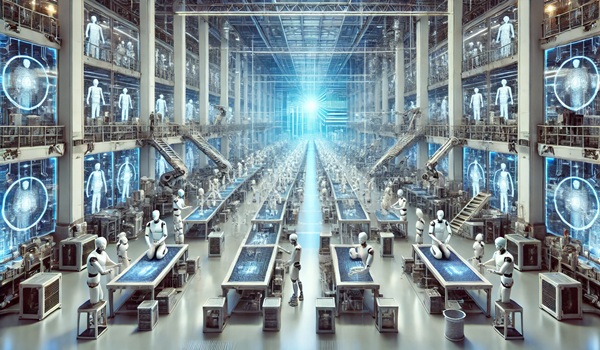
An AI factory enables the streamlined, automated production, deployment and management of intelligence and models in real time, encompassing all of the infrastructure, data, processes and other technologies required to do so. It’s like an assembly line for artificial intelligence. Data and electricity are “fed” into the factory, which applies energy, computing power and machine learning/AI processes to transform the data, and then produces intelligence, insights and predictions, or AI models and automation, or processed data that can be used for other purposes.
An AI factory isn’t just an idea or a concept, it’s also a physical facility on the scale of a data center. It’s very similar to a data center, actually, except that every bit of its hardware is dedicated to powering AI applications—oftentimes just one AI application. It’s an extraordinary concentration of computing power and electricity, and as we’ll see, AI factories are being used and planned for some extraordinary purposes.
Nvidia CEO Jensen Huang introduced the AI factory concept to the world in spring of 2024, likening it to a power generation facility—but instead of coal or natural gas or wind or sunlight, the primary raw material is data, and the output would be tokens of processed, transformed data. Huang’s vision was that every major company, in addition to their traditional, physical factories, would also need AI factories for operations and strategy.
Why Would a Business Want an AI Factory?
For one thing, what AI users eventually realize is that the technological solutions they need are usually not found in the capabilities of just one AI model—those solutions reside in a combination of models, or, preferably, an integrated combination of models trained on similar data and built to work together. But that’s hard to find, unless a business uses an AI factory to do it themselves.
Nvidia offers 5 benefits conferred to enterprises by AI factories:
Transform raw data into actionable intelligence that could be used to generate revenue.
Optimize, automate and streamline AI development every step of the way.
Boost energy efficiency, especially for high-workload AI use cases.
Improved AI scalability
Enhanced security and adaptability—models refine themselves over time, leading to improved outcomes.
Components of an AI Factory
Despite the certainty we’ve tried to give you so far, there’s still some disagreement aboout AI factories. The definition we’ve offered above is a relatively new one—before Nvidia began using the AI factory concept in its own marketing materials, it was sometimes used to describe a more conceptual framework for the mass production of AI models, and, in some cases, to refer to AI-powered smart factories (so there was some reason for our confusion!).
Similarly, some writers list four components of an AI factory, while others give five or more—and there’s no evidence that Nvidia itself ever settled on a list of AI factory components. Nevertheless, there is some consensus that an AI factory includes the following:
A Data Pipeline
Including methods and technology for continuous data collection, ingestion, cleaning and storage.
Model Development
Where the data is used to train AI models. This is not a simple matter of underpants gnome logic—where data and electricity go in, insights come out and a big question-mark exists in between. Machine learning algorithms manipulate and analyze the data, and software builds the models.
Model Deployment
After training, models are tested and refined, then enter production and are deployed via edge devices, the internet or internally.
Monitoring
As part of deployment, systems are established to track performance, latency and user feedback. This feeds into the…
Feedback Loop
New data from user interactions and monitoring systems are fed back into the AI factory to train new models, and retrain and improve existing models. Thus, an AI factory itself becomes an optimization engine for whatever problem or task it is being applied to.
How AI Factories Are Being Used
Manufacturing
AI factories make possible predictive maintenance, where manufacturers schedule proactive maintenance of tools and equipment to minimize breakdowns and down time. They can also help streamline workflows and aid in supply chain management and quality control.
Healthcare
AI factories are assisting with drug discovery and molecular formulation. They’re also helping to personalize and optimize treatments, including drug regimens and other interventions and therapies.
Retail
AI is being used to process customer data to help retailers make decisions and improve personalization. AI factories power inventory optimization and dynamic pricing strategies.
Finance
AI factories help power fraud prevention technology. They’re also being used in automated trading systems, forecasting and market predictions, and, increasingly, to power lending, credit scoring and underwriting tools.
Transportation
AI factories have become necessary components of autonomous vehicles. Autonomous vehicles cannot reliably read the road in real time and respond without the computing power of a specialized data center—what we’re now describing as an AI factory. AI can also be used in fleet and asset management, navigation and logistics.