
News/Commentary
Pope Leo XIV Stands Up to AI's Silicon 'Tower of Babel'
By DWN Staff · May 28, 2026 Views: 79
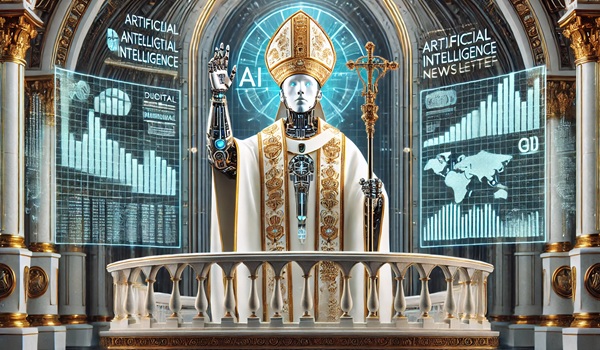
When Pope Leo XIV released his first encyclical, Magnifica Humanitas (“Magnificent Humanity”), many observers expected a broad statement on technology, ethics, and human dignity. Instead, they received something far more ambitious: a 42,000-word manifesto that places artificial intelligence at the center of the Church’s social teaching and frames AI as one of the defining moral, economic, and political challenges of the twenty-first century.
The encyclical, formally titled On Safeguarding the Human Person in the Time of Artificial Intelligence, draws a direct parallel between today’s AI revolution and the industrial upheaval that inspired Pope Leo XIII’s landmark 1891 encyclical Rerum Novarum. Just as the earlier pope confronted the social consequences of industrial capitalism, Pope Leo XIV argues that humanity must now confront the societal consequences of algorithmic power, automation, robotics, and digital concentration. (Vatican)
The document has already sparked intense debate among technology executives, policymakers, investors, academics, and religious leaders. Supporters view it as one of the most comprehensive ethical critiques of AI yet produced by a global institution. Critics argue it overstates technological dangers and risks slowing innovation. Regardless of where one stands, Magnifica Humanitas has quickly become one of the most consequential interventions in the global AI conversation.
AI, Babel, and the Human Person
The central argument of Magnifica Humanitas is not that artificial intelligence is inherently evil. Quite the opposite. Leo repeatedly acknowledges that technology has improved human life and can help educate, heal, connect, and protect people. However, he insists that technology is never truly neutral because it reflects the priorities and incentives of those who design, finance, regulate, and deploy it. (Vatican)
To explain the stakes, Leo structures much of the encyclical around two biblical images: the Tower of Babel and the rebuilding of Jerusalem under Nehemiah. Babel represents a technological civilization organized around domination, uniformity, and self-sufficiency. Jerusalem represents cooperation, shared responsibility, and community-oriented construction. According to Leo, modern societies face a similar choice as AI systems become embedded into daily life. (Vatican)
The pope warns repeatedly against what he calls a “technocratic paradigm,” a worldview in which efficiency, optimization, productivity, and control become the dominant measures of human value. Under such a system, people risk becoming data points, economic units, or algorithmic profiles rather than persons possessing inherent dignity.
One of the document’s most striking themes involves concentration of power. Leo argues that AI development is increasingly controlled by large private actors whose influence can exceed that of many governments. The combination of advanced algorithms, massive datasets, cloud infrastructure, and capital concentration creates what he views as an unprecedented form of private power capable of shaping economies, culture, and political life. (Vatican)
The encyclical also spends considerable time on misinformation, surveillance, algorithmic manipulation, autonomous weapons, digital dependency, and labor displacement. Leo argues that societies cannot simply trust markets to manage these challenges. Instead, he calls for democratic oversight, transparency, accountability, and international cooperation to ensure technology serves the common good rather than narrow interests. (Reuters)
Commentators quickly noticed that Leo’s concerns extend beyond AI itself. The document frequently targets the economic and political structures surrounding AI development. As Wired observed, the encyclical treats artificial intelligence not as a standalone technology but as part of the invisible infrastructure shaping work, information, and collective decision-making. (WIRED)
Online reactions were mixed. Reddit discussions ranged from praise for the pope’s focus on human dignity to criticism that a religious institution was inserting itself into technological debates. Some commenters on technology forums described the document as surprisingly sophisticated, while others dismissed it as overly pessimistic. LessWrong contributors praised its engagement with AI risks but questioned its limited discussion of artificial general intelligence. (The Verge)
How Magnifica Humanitas Compares With Earlier Catholic AI Thinking
Although groundbreaking in scope, Magnifica Humanitas did not emerge from nowhere. It represents the culmination of years of Vatican engagement with artificial intelligence.
Under Pope Francis, the Church increasingly addressed digital ethics through speeches, Vatican conferences, and initiatives such as the Rome Call for AI Ethics. Francis repeatedly warned against technological systems that undermine human dignity, expand inequality, or treat people as disposable.
Leo’s encyclical explicitly builds on Francis’ critique of the “technocratic paradigm.” In fact, entire sections of Magnifica Humanitas extend themes first explored in Francis’ encyclicals Laudato Si’ and Fratelli Tutti. Yet Leo pushes the discussion much further. Rather than discussing AI as one issue among many, he treats it as the defining social challenge of the present era.
The historical parallel with Rerum Novarum is equally important. Leo repeatedly invokes Pope Leo XIII’s response to industrialization and labor exploitation. Just as nineteenth-century Catholic social teaching sought to address the effects of factories, mechanization, and industrial capitalism, Leo argues that modern social teaching must address algorithms, robotics, data monopolies, and automation.
Observers across the political spectrum noticed the continuity. Conservative publications highlighted the encyclical’s emphasis on human dignity and limits on technological power. Progressive writers focused on its critiques of inequality, monopolization, and labor disruption. Meanwhile, Vatican officials emphasized that the document should not be read as anti-technology but as pro-humanity. (Financial Times)
What It Means for Financial Services
For banks, asset managers, insurers, wealth managers, and fintech companies, Magnifica Humanitas may be the most relevant papal document on finance since the global financial crisis.
Unlike many AI ethics statements, Leo specifically discusses credit allocation, finance, labor markets, and algorithmic decision-making. He warns that when algorithms influence lending decisions, hiring processes, or access to opportunities, those decisions must remain understandable, contestable, and subject to oversight. The goal is to prevent individuals from being reduced to statistical profiles.
The encyclical also draws a distinction between finance that supports productive economic activity and finance that exists primarily for its own sake. Leo argues that credit directed toward employment, entrepreneurship, and development fulfills an important social function, while purely speculative systems risk undermining human flourishing.
These concerns arrive as financial institutions increasingly deploy AI for underwriting, fraud detection, compliance, portfolio construction, customer service, risk management, and wealth advice. Banks are racing to automate large portions of knowledge work, while investment firms increasingly rely on machine learning models to generate insights and recommendations.
The pope’s framework effectively asks whether these systems enhance human judgment or replace it. It challenges executives to consider not merely whether AI improves efficiency, but whether it preserves accountability, transparency, and dignity.
Financial industry observers have already connected Leo’s concerns to ongoing debates about explainable AI, algorithmic bias, and concentration of power among major technology providers. CNBC reported that some traders and financial professionals saw parallels between the pope’s warnings and growing concerns about AI-driven labor disruption across finance. (Time)
Implications for AI Regulation
Perhaps the most immediate policy significance of Magnifica Humanitas lies in its regulatory implications.
Leo explicitly calls for stronger governance structures, international cooperation, and regulatory frameworks capable of directing AI toward the common good. He argues that technological power has become too consequential to leave entirely to private actors or market forces. (Reuters)
This places the Vatican closer to the European approach to AI governance than to the more laissez-faire tendencies often found in parts of the United States technology sector. The pope repeatedly stresses transparency, accountability, democratic oversight, and protection of vulnerable populations.
The timing is notable. Governments worldwide are struggling to balance innovation with concerns about misinformation, surveillance, labor displacement, and national security. The European Union continues implementing major AI regulations, while debates remain active in Washington, London, and other capitals.
Political reactions have been varied. U.S. Vice President JD Vance described portions of the encyclical as “very profound,” particularly its reflections on human dignity and technological change. (America Magazine)
Meanwhile, some free-market commentators warned that excessive regulation could entrench incumbents and slow innovation. Others argued that Leo’s concerns about concentrated technological power deserve serious attention precisely because a small number of firms increasingly shape global AI development. (Business Insider)
The Vatican has reinforced its commitment by establishing a dedicated AI commission intended to coordinate the Church’s response to technological developments and promote ethical engagement with emerging technologies. (Catholic World Report)
Leo Versus Jamie Dimon and Wall Street’s AI Optimists
One of the most fascinating aspects of Magnifica Humanitas is how it contrasts with many statements coming from financial industry leaders.
Executives such as Jamie Dimon, who we wrote about last week, along with leaders at major banks, asset managers, and technology firms, generally frame AI as a productivity revolution capable of improving efficiency, reducing costs, accelerating research, and enhancing customer experiences. Many predict enormous economic gains and substantial increases in worker productivity.
Leo does not deny these possibilities. However, he places much greater emphasis on the social costs and moral tradeoffs accompanying technological disruption.
Where many CEOs see automation as an opportunity, Leo asks who benefits and who bears the risks. Where investors focus on productivity gains, he asks whether dignity, community, and human responsibility are being preserved. Where technology firms often emphasize scale and optimization, he warns against reducing people to metrics and outputs.
Interestingly, not all technology leaders rejected the encyclical. AI pioneer Yoshua Bengio praised the Vatican’s engagement with AI ethics, while Anthropic cofounder Christopher Olah participated in discussions surrounding the encyclical’s release. (Business Insider)
At the same time, some entrepreneurs criticized the document as insufficiently optimistic about technological progress. They argued that disruption has historically improved living standards and that slowing innovation could produce its own harms. (Business Insider)
The resulting debate mirrors a larger divide throughout the financial and technology sectors: whether AI should primarily be viewed as an engine of growth or as a transformative force requiring extensive safeguards.
Is Leo Right?
As a recovering recovering Catholic, we're supposed to think this guy is pretty much infallible, but that doesn't mean we can't think critically about the encyclical.
The ultimate question raised by Magnifica Humanitas is whether Leo’s warnings are justified.
Supporters argue that the pope is addressing problems already visible today. Algorithmic bias, misinformation, surveillance technologies, labor displacement, and concentrated digital power are not hypothetical risks. They are active realities affecting millions of people. From this perspective, Leo is less a prophet of doom than a realist confronting existing trends. (WIRED)
Critics counter that the encyclical underestimates AI’s potential benefits. Artificial intelligence could accelerate scientific discovery, improve healthcare, enhance education, expand access to knowledge, and drive economic growth. Excessive caution, they argue, may slow progress that could improve billions of lives.
Yet the strongest aspect of Leo’s argument may be that it refuses both extremes. He neither embraces techno-utopianism nor advocates technological rejection. Instead, he insists that innovation must remain subordinate to human flourishing.
That position explains why the document has resonated far beyond Catholic circles. Even readers who reject its theological foundations often recognize the seriousness of its central questions: Who controls AI? Who benefits from it? Who is harmed by it? What remains uniquely human in an age of increasingly capable machines?
Those questions will not disappear. If anything, they will become more urgent as AI systems grow more powerful and more deeply embedded within economic, political, and social life.
Whether history ultimately judges Magnifica Humanitas as visionary or overly cautious, Pope Leo XIV has succeeded in accomplishing something rare. He has forced one of the world’s oldest institutions into one of the world’s newest debates, and in doing so has made artificial intelligence not merely a technological issue, but a moral one.