
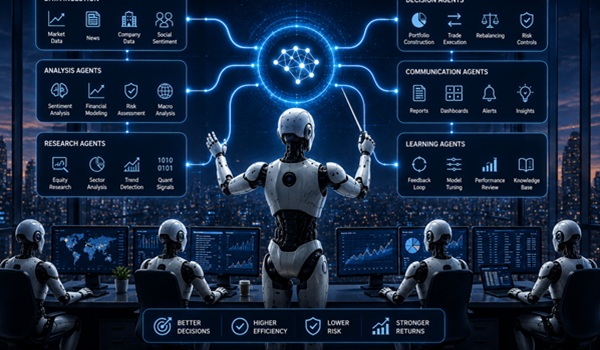
Each week we find a new topic for our readers to learn about in our AI Education column.
It takes two to make a dream come true. Or three. Or Four.
Anyway, it takes more than one person to do most things that people want to do from a business perspective. So it makes sense that it would take more than one AI tool to manifest our dreams, right?
A single LLM just responds to our prompts, which is great if we need it to answer a few questions—but we want AI that can keep up with our emails and calendars, and help us take notes in meetings, AI that helps us to write and work more productively. A single LLM can generate text—and plenty of it—but we want AI that can work.
That means we have to figure out how to make all these AI tools work together, a concept known as AI orchestration, a topic we’ve previously discussed here in AI Education. This week, we’re going to hone in on that concept with a discussion of orchestrated large language models, or orchestrated LLMs.
Orchestrated LLMs are AI models, not unlike the chatbots most of us query on a daily basis, that are combined with data sources, external software tools and other AI models to perform complex tasks.
AI Orchestration Versus Orchestrated LLM
These terms are used interchangeably, because they are somewhat new and nebulously defined. If we were to go search Google right now, we would find dozens of different, sometimes strikingly different, definitions of AI orchestration. We would also find many definitions of orchestrated LLMs that sound identical to the definition of AI orchestration. A lot of the content looks like AI slop. Let’s get a clarification.
AI orchestration is a framework or infrastructure connecting and coordinating multiple AI components or tools, making sure they work together coherently. Up to this point, anyway, AI orchestration is not really dynamic, it’s designed to predictably mirror a workflow and reliably make decisions in the context of that workflow within an organization. It operates as a layer within an AI system.
An orchestrated LLM, on the other hand, works more like a multidisciplinary AI agent—when given a task, it selects the tools and prompts it deems necessary to complete the work. Orchestrated LLMs are designed for autonomy. They’re dynamic in that they are empowered to decide which tools to use and when, and they’re flexible in that they can perform different tasks.
Elements of LLM orchestration
AI orchestration refers to both the orchestration concept and the infrastructure that makes orchestration happen. But an orchestrated LLM is itself a kind of orchestrator. The key element of an orchestrated LLM is workflow control. We interact with AI models via prompts that we write or voice sequentially, one at a time, honing in on what we’re looking for as we go. Orchestration can link multiple occurrences of this process together, using generative AI to choose which tools to prompt in which order.
At the heart of an orchestrated LLM is, well, a LLM. Or some sort of language model that it can call on to help it understand user requests and perform some reasoning functions. Furthermore, an orchestrated LLM can call on external software, data or processes to find and manipulate information for or from AI prompts. Here is where the LLM engages things like web search, databases, one or more CRMs, calculators, and APIs. An LLM might engage other AI agents designed to perform specialized functions. It might enable human-in-the-loop checkpoints, or automated compliance and verification checks,
Here, also, is where an orchestrated LLM might solve one of the biggest problems with single-model AI: memory. When we’re querying an AI model, leave, then return and start a new session or instance, the model usually has no long-term memory of what we’ve done in previous instances. There’s limited continuity across workflows over time. Orchestrated LLMs can help introduce some continuity into AI systems.
Orchestration Comes to Financial Services
Let’s consider finance, an industry with fragmented systems, complex documents, significant regulatory constraints, and thus far mostly isolated AI tools to help deal with these problems. Orchestration, writ large, is helping to connect the disparate but interlocking layers of finance, business and technology—and orchestrators are doing a lot of the work. Orchestration is also necessary for the next step in AI in finance.
To this point, AI has been an enabler, an information source, a writing assistant—something to make human workers’ hours on the clock more productive. Orchestration unlocks more autonomous systems in finance, because orchestrators can move between or exist across systems. Rather a human worker pivoting in their chair or tabbing between applications, orchestrators will do all the moving.
What Financial Orchestrated LLMs Can Do
In wealth management, the future is one in which client documents, estate plans, tax forms, investment policy statements and compliance records can become accessible to governed AI workflows. An advisor might ask for a client-ready summary of a household’s planning gaps, while the system retrieves relevant documents, checks permissions, drafts the answer and records the workflow for auditability. In capital markets, orchestrated LLMs can be used to parse loan agreements, monitor covenants, summarize earnings calls, compare private-market disclosures and build research briefs. The goal is not to replace analysts outright, but to compress the time spent collecting and structuring information so specialists can focus on judgment, negotiation and risk assessment.
Orchestrated AI agents can reason, execute complex tasks and pursue targeted goals across credit underwriting, treasury management and fraud detection. For finance teams, they can help close the books, explain budget variances, flag anomalies, prepare forecasts, reconcile accounts and generate management commentary. The value is not just automation, but coordination: one agent may extract data, another may validate it, another may draft a narrative and another may check policy compliance.
For expense management, an orchestrated LLM system can read receipts, match them to card transactions, check travel policy, route approvals, request missing information from employees and prepare data for ERP reconciliation
In lending, an orchestrated LLM can gather borrower documents, summarize financial statements, compare ratios to policy thresholds, draft credit memos and escalate exceptions. In fraud operations, agents can triage alerts, retrieve transaction histories, compare behavior patterns and prepare investigator summaries. In treasury, they can monitor exposures, liquidity positions and market data while surfacing recommended actions to human teams.