
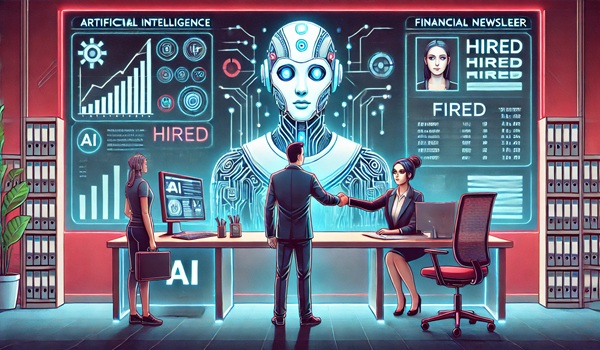
When Jamie Dimon speaks about the future of banking, Wall Street listens carefully. We don’t always do so here at AI & Finance, but his latest comments about artificial intelligence and hiring may prove to be among the most consequential labor-market warnings the financial services industry has heard in years.
In interviews and appearances this week, Dimon, the longtime chief executive of JPMorgan Chase, said the bank expects to hire “more AI people and fewer bankers” as automation reshapes how work is performed across the institution. The remarks landed at a moment when banks, fintech firms and software companies are increasingly confronting a difficult reality: artificial intelligence may not simply augment financial workers — it may permanently reduce the number of them needed.
Dimon’s comments are significant not merely because of his prominence, but because of JPMorgan’s role as the largest bank in the United States and one of the most technologically sophisticated financial institutions in the world. The bank has spent years investing aggressively in machine learning, automation, large language models and AI-driven productivity systems. Now, executives appear increasingly willing to discuss publicly what many employees and analysts have quietly suspected for years: AI deployment will alter the composition of the financial workforce in profound ways.
The implications extend far beyond investment banking. From retail banking to compliance, wealth management, trading, underwriting and back-office operations, AI systems are beginning to automate tasks once believed to require uniquely human judgment. While executives frequently emphasize that AI will create new opportunities alongside displacement, the emerging message from Wall Street leaders is becoming clearer: the industry may need fewer traditional financial workers in the years ahead.
Dimon’s Hiring Comments Break a Wall Street Taboo
For years, large financial institutions carefully framed automation initiatives as productivity enhancements rather than labor-reduction strategies. Executives often emphasized that technology would free workers to focus on higher-value activities, improve client service and expand growth opportunities. Dimon’s recent remarks represented a notable shift in tone.
According to reports from Bloomberg, Reuters and other outlets, Dimon acknowledged that JPMorgan intends to prioritize hiring employees with AI expertise while reducing the need for some traditional banking roles. The comments accompanied news that JPMorgan is rolling out additional AI tools across its investment banking division globally, accelerating the firm’s already extensive adoption of automation technologies.
The significance of those comments lies partly in their specificity. Wall Street executives have discussed digital transformation for decades, but they have often avoided explicitly connecting AI adoption to lower hiring demand for bankers and dealmakers. Dimon did not entirely abandon the industry’s traditional “AI creates jobs too” framing, but his comments suggested that the net composition of future hiring will change materially.
That change is already visible inside many financial firms. Banks increasingly seek engineers, data scientists, AI researchers, model governance specialists and prompt-engineering experts. Meanwhile, many entry-level and mid-level financial tasks — document review, research compilation, presentation generation, risk analysis, financial modeling assistance and compliance review — are becoming partially automated.
The result is a gradual but unmistakable restructuring of financial employment. Rather than expanding headcount proportionally with revenue growth, firms increasingly aim to scale through technology.
The Longstanding Belief That Finance Work Was “Safe”
For much of the past two decades, a dominant assumption persisted within professional services industries: technology would automate repetitive blue-collar or clerical work first, while highly compensated knowledge workers would remain relatively protected. Finance professionals often viewed their work as especially resilient because of the importance of client relationships, judgment, regulation and trust.
Even during earlier automation waves, banks continued hiring aggressively. Electronic trading reduced trading-floor headcount, but investment banking and advisory businesses expanded. Spreadsheet automation improved efficiency, yet armies of analysts and associates still filled conference rooms and office towers across New York, London and Hong Kong.
Many financial professionals therefore developed a deeply rooted belief that AI would function primarily as a “copilot” rather than a replacement.
That belief is now being challenged.
Modern generative AI systems can summarize research, draft client memos, generate presentations, analyze earnings transcripts, review legal documents and assist with coding tasks at speeds that dramatically reduce labor requirements for junior staff. AI systems are increasingly capable of performing not merely repetitive tasks but cognitively demanding analytical work once considered safe from automation.
Critically, many financial roles are structured around large pyramids of junior employees performing intensive information processing. Investment banks, consulting firms, accounting firms and asset managers traditionally relied on cohorts of analysts and associates to prepare materials for senior professionals. If AI significantly reduces the need for those junior layers, the entire structure of career progression may change.
This is why Dimon’s comments resonated so strongly online. They appeared to validate fears long circulating quietly among younger finance workers: the classic Wall Street apprenticeship model may be shrinking, or disappearing entirely.
At the same time, many economists and management consultants argue that fears of mass elimination remain overstated. Research from Brookings Institution and consulting firms such as Boston Consulting Group suggests AI may transform jobs more often than fully eliminate them. Hybrid human-AI roles could emerge across financial services, with workers supervising, validating and refining machine-generated outputs rather than producing everything manually.
Still, history suggests productivity gains eventually affect staffing levels. Banks adopting AI are unlikely to maintain identical headcount structures indefinitely if technology substantially lowers labor costs.
Standard Chartered, HSBC and Intuit Reinforce the Trend
Dimon’s comments did not emerge in isolation. They arrived amid a broader wave of corporate announcements linking AI adoption to workforce restructuring.
Standard Chartered recently announced plans to cut more than 7,000 jobs while increasing its use of AI technologies, according to reporting from Reuters and other outlets. Executives framed the changes as part of an operational modernization strategy intended to improve efficiency and competitiveness.
Meanwhile, HSBC chief executive Georges Elhedery publicly warned employees that AI would both create and destroy jobs across the financial industry. Rather than denying the disruptive potential of AI, HSBC leadership urged workers to adapt and retrain. The bank emphasized that future success would depend increasingly on technological fluency and the ability to work alongside AI systems.
Those comments marked another departure from earlier corporate messaging. Financial institutions once tended to minimize discussions about job displacement out of concern for morale, regulation and public relations. Increasingly, however, executives appear more willing to acknowledge disruption openly.
The pattern extends beyond banking.
Intuit, maker of TurboTax and QuickBooks, announced thousands of layoffs amid its aggressive AI transition. Although executives disputed claims that AI directly caused the cuts, critics argued the restructuring reflected broader automation-driven efficiency efforts unfolding across the software and financial technology sectors.
The convergence of these announcements is difficult to ignore. Major banks and fintech firms are simultaneously accelerating AI investment, restructuring workforces and rethinking hiring priorities. Even when companies avoid explicitly attributing layoffs to AI, the broader strategic direction is increasingly clear.
This dynamic has fueled anxiety among younger workers entering finance. Many fear that traditional career ladders may narrow dramatically if AI reduces the need for junior analysts, operational staff and middle-management positions. Others worry that financial firms could eventually adopt leaner staffing models similar to technology companies, relying on smaller teams amplified by AI systems.
Mark Levine’s Warning About New York Jobs
Dimon’s remarks also intersect with broader concerns about the economic future of New York City itself.
Recently, New York City Comptroller Mark Levine warned that artificial intelligence could eliminate thousands of jobs across the city, particularly within white-collar industries concentrated in Manhattan. Financial services remain one of New York’s most important economic engines, generating enormous tax revenue and supporting entire ecosystems of law firms, restaurants, real estate markets and professional services businesses.
Historically, technological disruption discussions often focused on manufacturing regions or logistics hubs. AI is changing that conversation by threatening highly educated professional employment concentrated in major urban centers.
If large banks gradually require fewer analysts, associates, operations specialists and support personnel, the impact could ripple through New York’s broader economy. Commercial real estate demand, commuter traffic, luxury retail activity and city tax revenues could all feel secondary effects.
Levine’s warnings reflect growing recognition among policymakers that AI’s economic impact may differ from previous automation cycles. Earlier technological revolutions often displaced routine manual labor while creating large numbers of administrative and professional jobs. AI threatens to automate portions of professional work itself.
That possibility carries particular significance for cities like New York, where finance and professional services dominate employment and tax bases.
Importantly, however, AI’s effects may not unfold evenly. Elite professionals with strong client relationships, specialized expertise or leadership responsibilities may remain highly valuable. The greatest pressure could fall on standardized, process-driven knowledge work that can be replicated or assisted by AI systems.
This could produce a “barbell effect” within finance employment: strong demand for elite senior talent and technical AI specialists, combined with reduced demand for large pools of mid-level and junior workers.
JPMorgan’s AI Investments Explain Why the Comments Matter
Dimon’s remarks carry extra weight because JPMorgan has spent years positioning itself as one of Wall Street’s leading AI adopters.
The bank reportedly invests billions annually in technology and employs thousands of engineers and technologists. JPMorgan has developed AI systems for fraud detection, risk management, customer service, trading support, research analysis and investment banking productivity enhancement.
According to JPMorgan’s own materials and outside research, the firm has explored generative AI applications capable of assisting employees with drafting communications, summarizing documents, generating coding support and automating operational workflows.
The bank’s AI ambitions are not theoretical. Reuters recently reported that JPMorgan has expanded AI tool deployment across investment banking teams globally, suggesting the firm is transitioning from experimentation toward large-scale operational integration.
This matters because JPMorgan often serves as a bellwether for the broader banking industry. When the bank invests heavily in a technology category, competitors frequently follow.
The combination of AI deployment and selective hiring changes suggests Wall Street’s AI transformation may be entering a new phase. Earlier years focused on proofs of concept and pilot projects. The current phase increasingly centers on operational scaling and measurable productivity gains.
If those productivity gains prove substantial, workforce reductions could become economically irresistible.
Notably, JPMorgan is not framing AI purely as a cost-cutting exercise. The bank views AI as strategically essential for maintaining competitiveness, improving customer experience and accelerating internal processes. Yet efficiency improvements inevitably carry labor implications.
Financial institutions face mounting pressure from shareholders to improve margins while simultaneously funding expensive AI infrastructure investments. Reducing labor intensity through automation offers a powerful way to accomplish both objectives.
Social Media Is Divided Between Fear, Cynicism and Optimism
Dimon’s comments sparked intense debate across social media platforms, Reddit forums, LinkedIn discussions and finance message boards.
On Reddit communities such as r/FinancialCareers and r/JPMorganChase, many users expressed anxiety that junior finance jobs may shrink dramatically over the next decade. Some posters argued that AI could hollow out traditional analyst pipelines, making entry into elite financial careers even more competitive.
Others dismissed fears as exaggerated. Several commenters argued that finance ultimately revolves around relationships, salesmanship, negotiation and trust — areas where human interaction remains essential. Some predicted AI would primarily increase productivity while preserving overall employment through business expansion.
LinkedIn discussions often reflected a more managerial perspective. Many executives and consultants emphasized “reskilling,” adaptability and the emergence of hybrid AI-enabled roles. Workers were encouraged to become fluent in AI tools rather than resist them.
Still, skepticism persists.
Some employees question whether promises of retraining and job creation will fully offset reductions in traditional roles. Critics note that previous automation waves frequently produced long-term labor displacement even when companies initially emphasized augmentation rather than replacement.
Public discussion has also become increasingly politicized. Some observers argue AI-driven restructuring could deepen inequality by concentrating productivity gains among large corporations and highly specialized technical workers. Others believe AI will ultimately lower costs, increase economic output and create entirely new industries and career paths.
The financial services industry sits at the center of that debate because it combines several characteristics that make it especially vulnerable to AI disruption: high information density, large volumes of repetitive analytical work, enormous labor costs and heavy digitization.
In many ways, Wall Street may become one of the earliest proving grounds for how generative AI reshapes elite professional employment.
Jamie Dimon’s comments resonate far beyond JPMorgan. They signal that one of the world’s most influential financial executives is now publicly acknowledging what many workers already suspected: artificial intelligence is not merely another software upgrade. It may fundamentally alter who gets hired, which skills matter and how financial careers evolve.
Whether AI ultimately produces mass displacement, widespread augmentation or some combination of both remains uncertain. But the era when large financial institutions could plausibly claim AI would have little effect on staffing appears to be ending.