
Each week we find a new topic for our readers to learn about in our AI Education column.
So we’ve decided to deploy AI in a workplace or across an enterprise. What are we actually doing?
Chances are pretty good that we’re not picking a single piece of software or one system and implementing a single piece of AI—we want it across an enterprise or transforming an entire workplace. We don’t want AI to do just one thing repeatedly—other technological forms of automation can handle single repetitive tasks without the expense or complexity of AI. We want AI that can multitask with expertise.
That probably means that we’re going to be implementing different types of AI, and different AI systems, in different areas of our enterprise or workspace, and integrating them with some other types of software, some of which will be new, some of which will be legacy.
How do we implement and use all of this technology in sucg a way that it all works together and delivers value to our organization?
That’s what this week’s AI Education, on the topic of AI orchestration, is going to help us answer.
AI Orchestration Defined
IBM defines AI orchestration as the coordination and management of artificial intelligence models, systems and integrations, encompassing the deployment, implementation, integration and maintenance of all these components within a greater system, such as a workflow, workspace or application. To be clear, as IBM defines the term, AI orchestration not only refers to software like AI models and AI agents, but also AI infrastructure, data, and the flow of that data through AI infrastructure, as well as how human users of any stripe interact with all of that technology. AI orchestration here acts as both command and the connective tissue of all of those people, resources and processes.
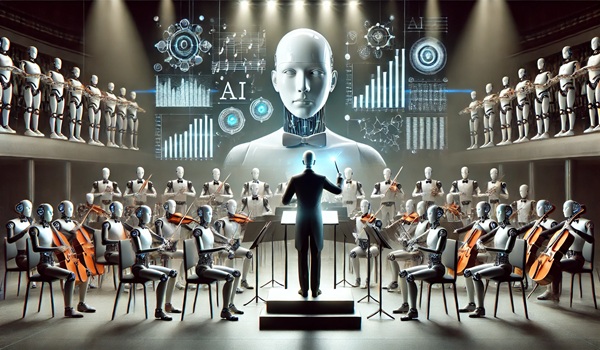
All of this “stuff” that makes up a modern AI technology stack doesn’t necessarily work together by design, yet there’s general consensus that we shouldn’t be placing different pieces of technology into data “silos” if we it can be avoided. Thus, there are a host of APIs, cloud platforms, databases and frameworks that literally put the pieces of our systems together and help them to work in concert, automating complex, multi-system workflows to make them appear seamless. So literally, an AI orchestrator is almost like a conductor, helping a large orchestra follow music and keep the beat with a hand and a baton.
AI orchestration does not define the processes by which we build and train new AI systems and models. It is not limited to merely managing the lifecycle of technological components. It’s better thought of as optimizing the combination of AI technology, processes and people to generate specific outcomes.
Components of AI Orchestration
Integration
As in wealthtech, integration here is the connections between AI tools, databases and other components. The movement of data is particularly important to integration, as is the normalization, validation and enrichment of data.
Automation
The completion of tasks without human intervention. AI orchestration involves the automation of some or all of a workflow, but orchestrators can also automate AI management, decision-making and maintenance.
Management
Here, management refers to automated oversight of an AI’s lifecycle, including performance monitoring, versioning and updating.
Governance
AI orchestration can be used to apply guardrails for security and compliance purposes, as well as for ethical concerns.
What is AI Agent Orchestration?
AI Agent Orchestration, in a definition we’re going to cobble together from multiple sources on the web, is a related but non-synonymous term describing the management and integration of multiple role-specific AI agents to achieve one or more shared objectives. Wherever we see compound AI at work, what we’re probably not immediately seeing is some sort of AI agent orchestration. Unlike AI orchestration in general, AI agent orchestration only describes the software side of things: it is a subset of AI orchestration.
AI agents are autonomous, specialized actors—in AI agent orchestration, layers of agents might work in conjunction to power a platform. IBM offers the example of a customer service automation where an orchestrator agent might have to decide whether to engage different type of agents—a billing agent, for example, or a technical support agent—based on customer requests. Or in the financial sector, an AI orchestrator can help connect the AI agents responsible for monitoring for fraud to the appropriate agents to respond to suspicious activity, automating more of the fraud prevention and incident response process.
An AI agent orchestrator not only makes sure the right agent is engaged, but also that the right data is handed off to that agent, and in a way that the agent can use the data to produce the needed or desired outcome. Just as mere organizational charts and flow charts often fail to accurately describe the intricate webs of components within real-world systems, there isn’t a single style of AI agent orchestration—it can be centralized with a single orchestrator “brain,” or decentralized to a group or community of agent orchestrators, or orchestrated using a variety of hierarchies.
Yeah, Orchestration Sounds Complex, But…
To some extent, orchestration platforms help simplify the complex, since we’re taking multiple pieces of software, hardware, integrations and interfaces and placing them within a single framework that is predictable, dependable, potentially more explainable, and more easily maintained over time. Orchestration has become necessary for scaling complex applications of AI, as it helps make sure multiple components fit together coherently within a system in a repeatable manner.
Today’s AI orchestration tools are increasingly automated by their own use of AI, and are capable of managing and coordinating multiple models into coherent custom workflows without a lot of intermediation. Low-code and no-code processes can make the complex task of orchestrating multiple AI workflows a matter of talking about what we want and need king about what we to a chatbot or a smart speaker.
So, instead of asking how a single AI model like Claude or GPT can help transform our business processes, this is more like asking a Claude or GPT to integrate contributions from an entire range of AI models to help transform our business processes. Thus, orchestration platforms potentially help small- and medium-sized enterprises solve complex and specific business problems without the need to create bespoke models, to understand how to train or program models, or to know how to write a single line of code.