
The Lead
The Lead: April, Wars, Rockets, and Quiet Landmines
By Bill Taylor · Apr 13, 2026 Views: 47
Well here we are, well into April. Spring Break is either winding down or long gone, depending on which TSA line still haunts your dreams. Major League Baseball is underway, March Madness has exited, and the NBA playoffs have arrived to remind us that time is a flat circle—just with different jerseys.
Most readers know by now that Cindy — Founder, Publisher, and the actual grown‑up at DWN and AI & Finance — recently succumbed to a vicious, fast‑moving cancer. She still “hangs around” my head, editing my thoughts, correcting my grammar, and occasionally telling me to behave. Our readers, our friends, and I miss her more than words, but she’s still very much in the room.
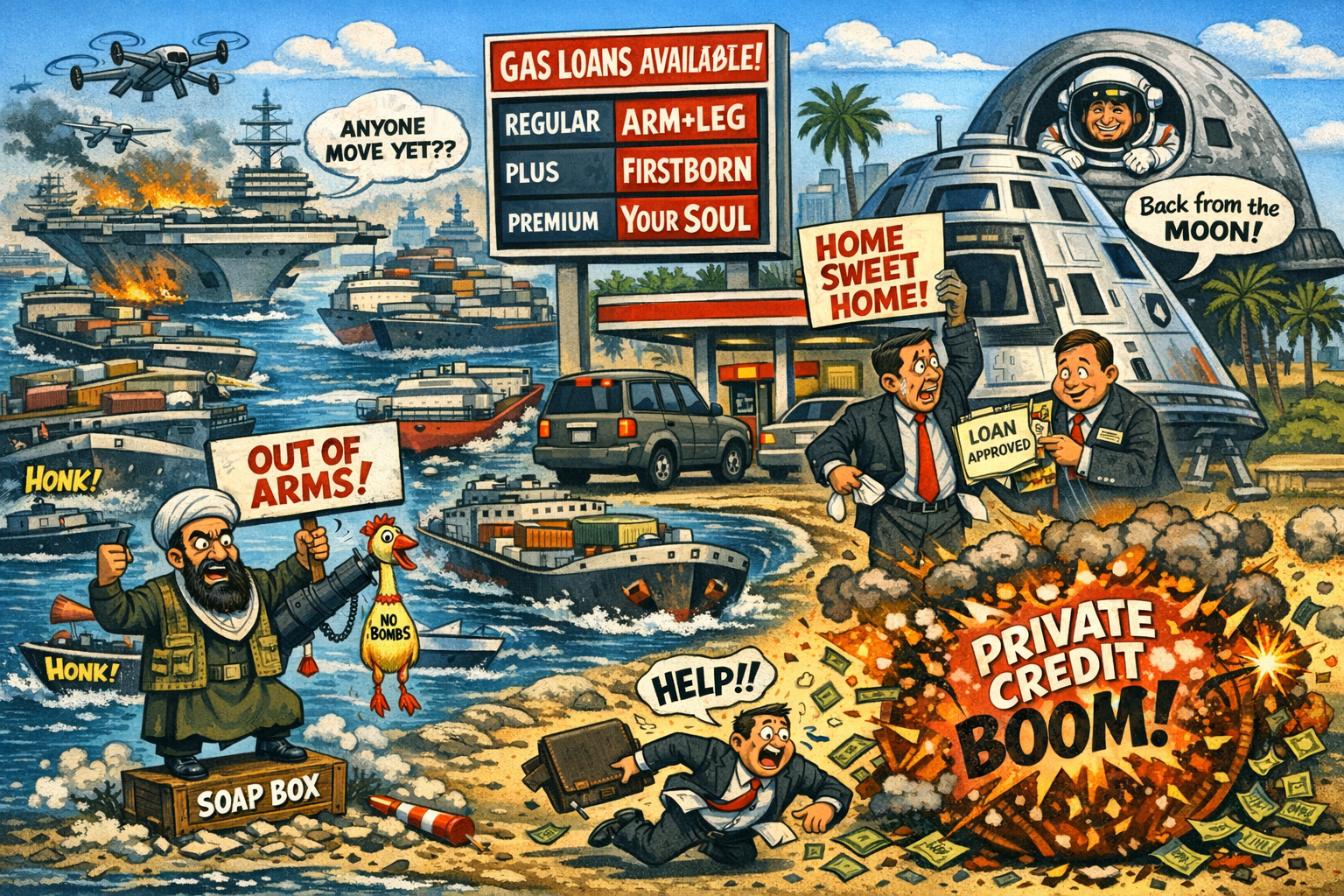
Moving on—is it time to end this Iran war? Everyone outside a defense contractor boardroom would say yes. Instead, we’ve now escalated to the U.S. formally blockading Iranian ports and partially blockading the Strait of Hormuz, while insisting we’re “not impeding freedom of navigation” for non‑Iranian ships. Iran calls it piracy, Washington calls it leverage, and the rest of the world calls it “why is my gas so expensive?” Oil is spiking, shipping is snarled, and more than 600 vessels are effectively stuck in the Gulf waiting for the adults to show up.
On the bright side, at least we’re not shooting at the moon. Artemis II is back, safe, and home, after swinging around the far side of the moon and setting new distance marks for a crewed spacecraft. The mission did what it was supposed to do: prove we can still run an insanely complex operation without blowing anything up. Somewhere, Cindy is nodding and saying, “See? When you test things first, they work.”
Now, the sleeper villain: Private Credit. This isn’t just a “finance nerds only” topic anymore. Private credit funds have ballooned into the trillions, lending to companies that can’t—or don’t want to—borrow from traditional banks. It all worked great when money was free and nobody asked too many questions. Now investors are trying to get their money back and discovering that “quarterly liquidity” can magically turn into “not today, maybe later.”
You’ve got illiquid loans, opaque valuations, and leverage on top of leverage—including those charming NAV loans where funds borrow against their own portfolios to pay investors who are trying to leave. If that sounds like using one credit card to pay off another, that’s because it basically is. When rates stay high and growth slows, defaults don’t politely knock; they kick the door in. This is the kind of slow‑burn problem that doesn’t make headlines—until it suddenly does.
And yes, if you haven’t noticed, gas prices are up again. The war, the blockade, the tankers parked like it’s a floating Costco parking lot—it all rolls downhill to the pump. Beverly Hills is still a great place to see $7 gas and people pretending not to notice.
Stay tuned. The soap opera isn’t over; they’re just adding new characters.